

Food preservation has changed somewhat beyond easy canning and dehydration. For families and organizations focused on long-term food protection freeze drying machine engineering currently presents the silver normal in preservation. While when the special domain of professional operations and place agencies, innovations in production have created this technology available for residential use.
The following evaluation handles the absolute most critical questions concerning the efficiency, durability, and natural retention of freeze-drying machines in comparison to standard storage methods.
How can the sublimation method really perform?
Freeze drying, or lyophilization, works on a theory distinctive from normal dehydration. While dehydration employs temperature to escape moisture—frequently altering consistency and vitamin content—freeze drying employs sublimation. The equipment stops the substance to temperatures between -30°F and -50°F (-34°C to -45°C). Once frozen, a vacuum push lowers the stress around the food.
That machine atmosphere enables the icy water in the meals to transition directly from a good (ice) to a gas (vapor), skipping the fluid stage entirely. This technique eliminates approximately 98% to 99% of moisture. By contrast, conventional contamination on average removes just 90% to 95% of water material, making enough recurring moisture to probably let bacterial growth around extended periods.
What's the mathematical difference in rack life?
When analyzing long-term storage options, the principal full is corner life. Data indicates a huge comparison between storage methods.
• Processed Things: Home-canned food usually stays secure and welcome for three to five years.
• Frozen Food: Strong cold retains quality for 1 to 2 years before freezer burn up or consistency destruction occurs.
• Dry Food: With proper appearance, dry products can last 15 to 20 years, nevertheless structure often degrades around time.
• Freeze Dried Food: When packaged in Mylar bags with air absorbers, freeze-dried food features a rack life of 25 to 30 years.
The mathematical advantage here's significant. A freeze-drying device offers a storage window roughly 500% longer than old-fashioned canning, making it the superior choice for emergency ability and long-term present management.
Does the procedure degrade nutritional price?
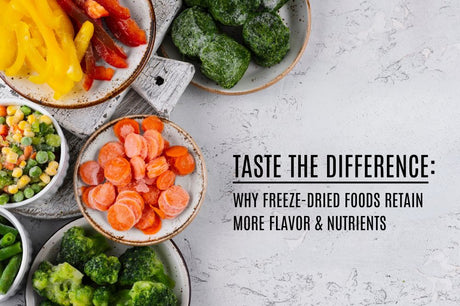
One of the very engaging fights for freeze drying is nutrient retention. High temperature, that will be necessary for canning and contamination, destroys heat-sensitive supplements like Supplement C and Supplement A.
Studies reveal that freeze-dried ingredients maintain around 97% of their unique natural value. In contrast, contamination maintains about 60%, and canning usually keeps significantly less than 40% because of the large conditions mixed up in sterilization process. For those depending on saved food for sustenance throughout emergencies, this nutritional thickness is vital. This means consuming less quantity to accomplish exactly the same caloric and supplement intake.
May be the engineering functional enough for complete meals?
A common restriction of conventional storage is the shortcoming to method complex foods. Dehydrators struggle with milk and high-fat meats.
Freeze drying models are statistically more versatile. They are able to properly process:
• Dairy: Dairy, cheese, and yogurt keep their bio-structure and rehydrate effectively.
• Cooked Meals: Unlike canning, which needs certain pH levels for security, freeze dryers may method fully prepared entrees, including lasagna, casseroles, and soups.
• Natural Meats: Raw proteins could be stabilized without preparing, keeping texture for potential preparation.
Future-Proofing Your Offer Chain
Purchasing a freeze-drying unit is fundamentally an expense in source efficiency. By reducing food spend and increasing the viability of perishable goods by decades, households and organizations can build a powerful, nutrient-dense food supply that stays stable aside from outside present sequence disruptions.